From Concept to Hydrogen Propulsion: How a Turnkey Solution Is Created
Hydrogen propulsion is not achieved by selecting a single component.
In complex technology projects, customers often do not come with a ready-made solution. They do not come with a precise list of components, a wiring diagram, or a prepared technical design. Instead, they often come with an idea, a machine, a platform, or a vision into which they want to integrate a hydrogen or zero-emission powertrain.
It is at this very moment that the most important part of the development process begins. Not during assembly. Not when selecting a fuel cell. Not when purchasing a battery or a pressure system. It begins with the question of whether the solution is feasible from a technical, safety, space, operational, and regulatory standpoint.
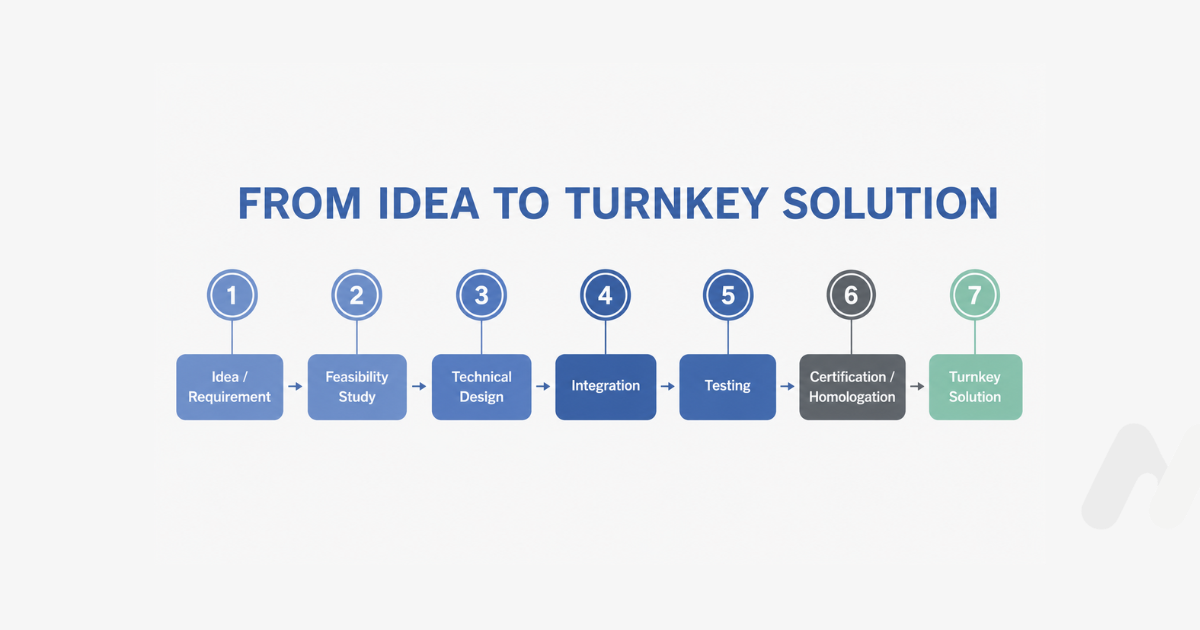
At Mobility & Innovation Production, we view such projects as a comprehensive process. From the initial idea and feasibility study, through technical design, system integration, and testing, to a solution ready for the next steps in technical development, certification, or homologation.
Between the initial idea and a functional hydrogen propulsion system, there are many decisions that will affect the safety, reliability, and usability of the entire solution.
Customers don’t always come in with a fully formed request
In practice, a customer often knows what they want to achieve but doesn’t yet know what the technical solution should look like. This could be a machine manufacturer, a technology company, a platform owner, or a designer looking for a way to integrate a hydrogen or zero-emission powertrain into their solution.
So the question isn’t just: Which component should we use?
The more important questions are:
What does the machine or vehicle need to be able to do in practice? How much power does it need? How much energy will it actually consume? Where will the hydrogen system be located? What are the space, weight, and safety limitations? What regulations will the solution need to comply with?
Without these answers, development would very quickly devolve into simply assembling components without a clear technical logic. With hydrogen propulsion, however, it is not enough for individual parts to function independently. They must be designed to work together as a single functional system.
Feasibility Study: What Is Realistically Possible
A feasibility study is not an administrative step. It is a technical phase that helps determine whether a solution makes sense and under what conditions it can be implemented.
For hydrogen and zero-emission propulsion systems, several areas are being evaluated simultaneously at this stage. These include technical feasibility, safety, available space, weight, operational requirements, energy balance, control and diagnostic requirements, as well as preparation for certification or type approval.
The goal is not merely to confirm that the technology exists. The goal is to determine whether a specific solution can be designed in such a way that it has a chance of working under real-world conditions.
A feasibility study helps identify technical limitations before a project moves on to the development and integration phases.
It is often at this stage that decisions are made regarding whether a project requires a different architecture, a different component layout, a different power capacity, or a different system management approach.
Design of a Hydrogen Energy Source and Electric Propulsion System
When it comes to hydrogen propulsion, it is important to describe exactly what is happening in the system in technical terms. Hydrogen is not a mechanical propulsion system. Hydrogen serves as an energy source. A fuel cell converts hydrogen into electricity, and the electric motor provides the actual propulsion.
This means that designing a hydrogen propulsion system is not just a matter of fuel cells or tanks. It involves designing the entire energy and propulsion chain.
The system consists of a hydrogen energy source, a fuel cell, a battery, an electric drive, a high-pressure hydrogen system, power management, safety logic, software, and diagnostics. Each component has its own function. However, what matters most is how these components communicate with each other and how the system behaves as a whole.
Therefore, when designing a system, it is not enough to simply consider which component is technically the most powerful. What matters is how it fits into a specific application, what interfaces it will create, and what demands it will place on security, management, maintenance, and testing.
High-pressure system, batteries, control system, and software
A hydrogen propulsion system is dependent on the proper design of the interfaces between its individual components. The fuel cell, high-pressure hydrogen system, battery, and electric motor cannot function as isolated units.
The high-pressure system must be designed with safety, space, pressure, monitoring, and system responses in mind. The battery helps manage power peaks, system stability, and coordination with the fuel cell. The control system must evaluate the status of individual components, manage energy flow, and respond to both normal operating conditions and fault conditions.
Software is therefore one of the key layers of the entire solution. It is not merely an add-on to the hardware. It determines how the system communicates, how it behaves when conditions change, how it protects itself and its surroundings, and how it provides data for diagnostics.
With hydrogen propulsion, value isn’t created solely by the components themselves. It arises primarily from how they are interconnected, controlled, and prepared for specific operations.
System Testing and Validation
Testing is not the final check at the end of development. For complex propulsion systems, testing is an integral part of development from the very beginning.
The testing does not merely verify whether the system starts up. It also verifies how the system responds under load, how the fuel cell interacts with the battery, how the power management system functions, how the system behaves when its state changes, and how it responds to error or safety scenarios.
Validation helps determine whether a solution operates stably and consistently. It also identifies areas where the technical design, software, control system, or diagnostics need to be adjusted.
That is why testing is important not only for the technical team but also for the next steps in the project. The test results form the basis for documentation, safety assessments, and preparation for certification or type approval.
Preparation for certification, type approval, or handover
A functional concept does not necessarily mean that the solution is ready for use. When it comes to hydrogen and zero-emission propulsion systems, the project must also be prepared for further technical and legislative steps.
This includes documentation, safety logic, test results, diagnostics, technical documentation, and preparation for testing in accordance with relevant requirements. For vehicles, this may involve type-approval procedures. For other machines or technologies, this may involve certification, technical assessment, or handover of the solution to the customer.
It is important that the system not exist merely as a working prototype. It must be understandable, documented, tested, and ready for further use.
A turnkey solution isn’t about delivering a single component. It’s about taking responsibility for the entire technical process.
MIP: Your Partner from Concept to Turnkey Solution
Mobility & Innovation Production participates in projects as a technology partner for the comprehensive system integration of hydrogen and zero-emission powertrains. Our role is not merely to select a component or supply a single part of the solution.
We help you navigate the entire process—from the initial idea, through the feasibility study, technical design, integration, testing, and documentation, all the way to a solution ready for the next steps in technical evaluation, certification, or type approval.
This approach can be applied to various types of platforms—from hydrogen buses to heavy-duty transport to specialized applications, such as a hydrogen drone. Each project has a different architecture, different limitations, and different requirements. However, the principle remains the same: to design and integrate the system so that it functions as a whole.
For the customer, this means that they are not just coming to a component supplier. They are coming to a partner who can help them determine whether their vision is feasible, how to approach it from a technical standpoint, and what needs to be done to turn it into a functional solution.
From idea to turnkey solution.
Developed in Slovakia. Built for real-world use.
Read also
When Technology Isn’t Enough: Why Complex Solutions Require Systems Thinking
From Technology to Live Operation: What a Functional System Must Be Able to Do
