Logistics 2030: How fleet architecture will change
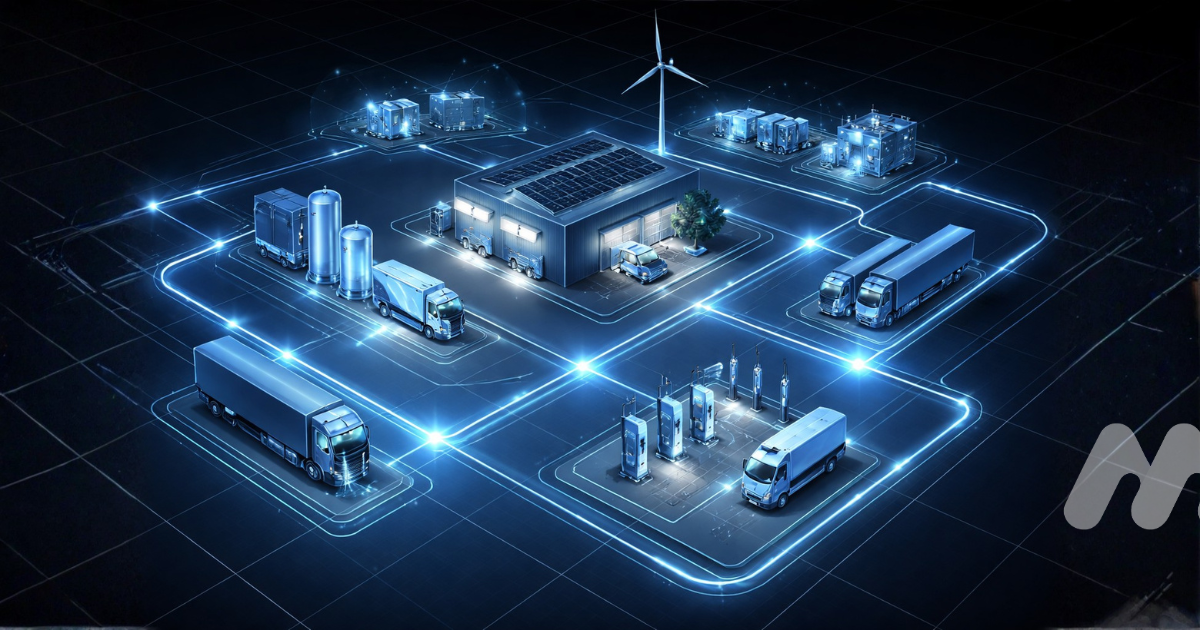
The 2030 fleet architecture will not just be about replacing one type of vehicle with another.
The very logic of planning, energy management and decision-making of carriers will change. Companies that are addressing zero-emission operations today are actually deciding what their competitiveness will look like five years from now.
The question is no longer “what vehicle to buy”, but “how to design a working system”.
From the individual vehicle to the energy ecosystem
The model so far has been simple.
The car was driven, refuelled, serviced. The fleet was a collection of identical pieces of equipment.
In 2030, the situation will be different.
The fleet becomes a combination:
- 🔹 electric vehicles,
- 🔹 hydrogen vehicles,
- 🔹 of hybrid solutions,
- 🔹 of intelligent route planning,
- 🔹 energy management and data analytics.
This means that the 2030 fleet architecture will be more about energy strategy than about propulsion itself.
This is where System Integration of drives comes into play – the ability to link technology, infrastructure and operations into a single functional unit.
Emission-free operation as part of business strategy
Emission-free operation will not just be a response to regulation.
It becomes part of the business strategy.
International logistics companies are already setting ESG criteria for their partners. Banks and investors are monitoring the carbon footprint. Customers demand transparency in supply chains.
According to the European Commission, the pressure to decarbonise transport will gradually increase under the 2030 climate targets (source: European Commission – Climate Action).
This means that the Fleet Architecture 2030 will affect:
- – access to finance,
- – access to customers,
- – brand reputation,
- – the long-term value of the company.
Infrastructure and vehicles will be developed in parallel
One of the biggest mistakes in market thinking is the idea that the perfect infrastructure must first be in place.
The reality is different.
Infrastructure and technology are evolving in parallel. Early players are influencing its shape, locations and standards.
Therefore, the Fleet 2030 architecture will be closely linked to:
- 🔹 hydrogen filling planning,
- 🔹 by local recharging,
- 🔹 by optimizing routes,
- 🔹 regional energy capacities.
The carrier that starts earlier gains experience, data and a head start.
Data as the foundation of the new fleet
In 2030, the biggest advantage will not be the vehicle itself.
It will be the ability to work with data.
Every kilometre, every hydrogen fill, every charge will generate information.
These will enable:
- ➡️ optimize costs,
- ➡️ to schedule maintenance,
- ➡️ drive energy spikes,
- ➡️ accurately calculate TCO.
The Fleets 2030 architecture therefore also includes data integration. Without it, emission-free operation becomes just a technology without a strategy.
The role of the system integrator
Fleet transformation is a complex process.
It includes needs analysis, customized drive design, component selection, testing, homologation and commissioning.
This is where the importance of a partner that is not tied to one technology becomes apparent.
Mobility & Innovation Production takes a technology-independent approach to projects.
The future of mobility is not about one technology, but about the right solutions in the right place.
What should the carrier address today?
If the 2030 Fleet Architecture is to work, the first questions need to be asked now:
- 🔹 Which routes are suitable for emission-free operation?
- 🔹 Where will it be possible to fill hydrogen or charge?
- 🔹 What model of pilot project will reduce the risk?
- 🔹 How will data be integrated into fleet management?
Transformation does not start with the purchase of a vehicle. It starts with the decision to prepare the system.
Conclusion
The Fleet Architecture 2030 is not a theoretical concept. It is a reality that is already taking shape.
Carriers that think systemically today will have a more stable, efficient and competitive fleet in a few years’ time.
MIP stands on the side of solutions that work in practice – from analysis to emission-free operation.
